
In 2020, gaming revenue in Indonesia reached US$1.74 billion, with 99.51 percent of it dominated by foreign entities and only about 0.49 percent enjoyed by domestic ones. A market that size with a domestic share that small is not a content problem, and Indonesia stopped treating it as one in February 2024.
For legal and market entry leads at foreign publishers, exposure is procedural rather than editorial. A title can be rated, localized, and live on every storefront while the entity behind it sits outside the structure the government has been building since then. Most Indonesia compliance checklists start with the rating system, the layer with a portal, a certificate, and a deadline.
Presidential Regulation 19/2024 is not a rating rule. It is a national game regulation roadmap binding on ministries rather than studios, and one line in its annex decides what legal form a foreign publisher is expected to hold before any content question matters.
What PR 19/2024 Actually Is and Why Indonesia Issued It
Former President Joko Widodo signed Presidential Regulation No. 19 of 2024 on the Accelerated Development of the National Game Industry on 12 February 2024, effective the same day. Its Indonesian title, Percepatan Pengembangan Industri Gim Nasional, carries the intent better than most English summaries: it is an industrial policy rather than a conventional game regulation, complete with target years and specific deliverables on every annex line.
Foreign dominance on this scale meant value created by Indonesian players was leaving the country almost entirely. Instead of attempting to restrict player demand, the state chose to intervene on the supply side, restructuring how foreign publishers must operate within the domestic market.
Presidential Regulation 19/2024 is a comprehensive game industry roadmap designed to strengthen Indonesia’s gaming ecosystem. It deploys cross-ministerial assignments across key strategic areas, including research, education, financing, infrastructure, marketing, and intellectual property.
Hogan Lovells recorded the sector as one of the top three fastest-growing industries in Indonesia’s creative economy, projected to reach US$2.5 billion by 2025, quoted domestically as IDR 36 trillion. Indonesia’s game industry is building toward one where that spending has somewhere local to land, the same demand signal that brought Nintendo into the market officially.
That is context. The part that changes what a publisher must do sits further down the annex.
The Requirement That Affects Foreign Publishers: Legal Entity or Local Partnership
![Foreign game publishers may establish an investment subsidiary or partner with a domestic publisher in Indonesia.]](https://speequalgames.com/wp-content/uploads/2026/09/image-46-1024x664.jpeg)
The operative line is program detail 5.1. Hukumonline reads it as a mandate for implementing rules that will require foreign game publishers with significant economic impact to establish a legal entity in Indonesia and partner with a domestic company. Two qualifiers are important: the obligation targets publishers with a significant economic footprint, and it is established through derivative regulation rather than the presidential text, making it more of a direction of travel instead of a dated deadline.
The foreign game publisher legal entity that Indonesia expects is a limited liability company, formed as a foreign direct investment subsidiary or a joint venture with a domestic publisher. That vehicle needs a business activity code, and none existed for game publishing when the regulation was signed, which is why the annex ordered one. It now exists. KBLI 2025, issued under BPS Regulation 7 of 2025 in December 2025, split the old software publishing classification into 58211 for online video game publishing and 58219 for other video game publishing, and OSS began applying it to registrations in June 2026.
Enforcement runs through access rather than penalties. Publishers without legal entity status may face blocking measures by the communications ministry, which removes a title from players rather than billing its owner. That ministry is now the Ministry of Communication and Digital Affairs, restructured under Presidential Regulation 174 of 2024 with a directorate general dedicated to enforcement in the digital space.
Corporate status is one track. The other is the one most publishers already run.
How PR 19/2024 Connects to Rating and Classification Requirements
Annex item 5.2 of the presidential roadmap instructs the communication ministry to sharpen Ministerial Regulation 11 of 2016 on the classification of electronic interactive games, ensuring every title operating in Indonesia aligns with national values. That directive is the origin of the rating layer publishers deal with today. The amendment arrived as Regulation 2 of 2024 on Game Classification, effective 24 January 2024, just weeks before the presidential regulation was signed, which is why the two instruments are quoted together so often and confused almost as frequently.
The IGRS game rating regulation Indonesia now enforces has left its grace period. January 2026 marked the end of the two-year transition under the Game Classification Regulation and the start of full enforcement, with self-classification through the IGRS portal, a conformity review, and an approval certificate. Sanctions escalate from written warnings to temporary suspension and permanent restriction of access, so it pays to understand how game rating works in Indonesia before a submission window opens.
Indonesia’s game publishing compliance, therefore, runs on two tracks. A rated title from an entity with no Indonesian presence satisfies the content requirement and leaves the corporate one open, while a correctly formed local entity shipping an unrated build fails at the storefront. Sequencing them together is the point of a step-by-step approach to legal alignment before distribution.
Both are obligations. The same regulation also carries incentives, half of market-entry plans routinely miss.
What This Means Practically for Market-Entry Planning
![Early compliance planning helps game publishers avoid costly launch-week problems.]](https://speequalgames.com/wp-content/uploads/2026/09/image-47-1024x683.jpeg)
The annex is a program table, not a prohibition list. Program 2.6 tasks the finance ministry with tax facilities for game developers and publishers, including pioneer industry status, Special Economic Zone access, and revised corporate income tax facilities. Neighboring items fund training and prototype targets, build intellectual property financing with the banking sector, and open a policy track for highly skilled foreign game talent.
Ownership of that agenda is where the text and current practice diverge. Article 5 places the acceleration team under the Coordinating Minister for Maritime and Investment Affairs, and the Coordinating Ministry for Maritime and Investment Affairs’ gaming mandate was accurate on the day of signing. That coordinating ministry was dissolved on 20 October 2024, with most of its investment coordination absorbed by the Coordinating Ministry for Economic Affairs. Teams working out how to publish video games in Indonesia legally, including the task force structure, should confirm which body holds the file now.
Indonesia’s game market entry requirements run on two workstreams that move at different speeds. Entity formation, KBLI selection, and OSS registration are corporate workstreams measured in months. Classification is a product workstream tied to the build and its localized text. Incentives sit behind the corporate track, since pioneer status and tax facilities attach to a registered Indonesian entity. Treating legal compliance services as a launch week purchase collapses entity formation, classification, and incentive planning into the worst possible order, the failure mode a regional compliance playbook exists to prevent.
Neither side moves quickly, which is why both belong on the same timeline.
Conclusion: Structuring Your Game Launch for Success in Indonesia
Presidential Regulation 19/2024 is not the rating rule it is frequently mistaken for. It sits above Indonesia’s game regulation architecture rather than beside it, and it has already produced two concrete outcomes: a dedicated publishing classification inside KBLI 2025 and the classification rules that became IGRS in full enforcement from January 2026.
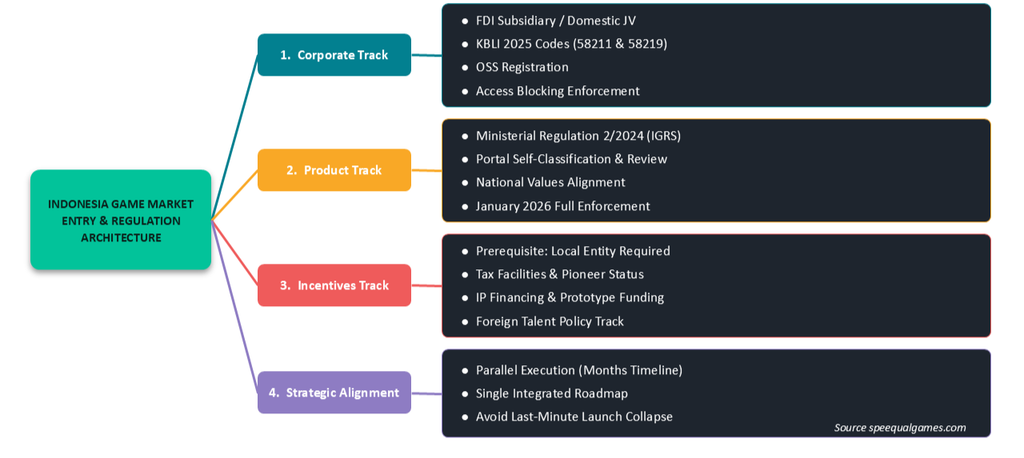
Reading it properly means holding both halves at once, the legal entity or local partnership requirement and the incentives attached to it, and putting both on the market entry timeline at the start rather than meeting them one at a time as problems.
SpeeQual Games brings 24+ years of localization expertise to that work as an Indonesia game localization and compliance partner, aligning rating submissions with the corporate track instead of treating them as separate errands. Our rating and classification support covers IGRS documentation, terminology audits, and regional submissions across Southeast Asia. Talk to us before your Indonesia timeline locks, and we will map the compliance path alongside it.
![Understanding regional gaming regulations is key to launching successfully across Southeast Asia.]](https://speequalgames.com/wp-content/uploads/2026/09/image-10.jpeg)
![Localized voice and subtitles helping mobile games connect with Thai players.]](https://speequalgames.com/wp-content/uploads/2026/09/image-8.jpeg)

![Localization from day one helps games to connect with players throughout Southeast Asia.]](https://speequalgames.com/wp-content/uploads/2026/08/image-21.jpeg)