The evolution of RPGs in 2026 indicates a distinct shift from scale to simulation. Open-world games are no longer just massive landscapes; they are becoming interactive ecosystems in which every action affects the world in real time.
Fable (2026) emerges as a new benchmark in this change. Set in Albion, the game has a “living population” of over 1,000 NPCs, each with their own habits, relationships, and emotions influenced by player behavior. This creates a world that seems alive, with reputations and decisions rippling across communities.
Looking ahead, the challenge in RPGs (Role-Playing Games) will be to create richer worlds rather than bigger ones. Developers are increasingly focusing on interconnecting procedural storytelling—systems in which storylines develop organically from player actions rather than scripted paths.
Is the era of scripted RPGs coming to an end? Explore the architectural shift toward procedural world-building and living ecosystems in our 2026 deep dive.
Procedural Storytelling: Moving Beyond Scripted Events
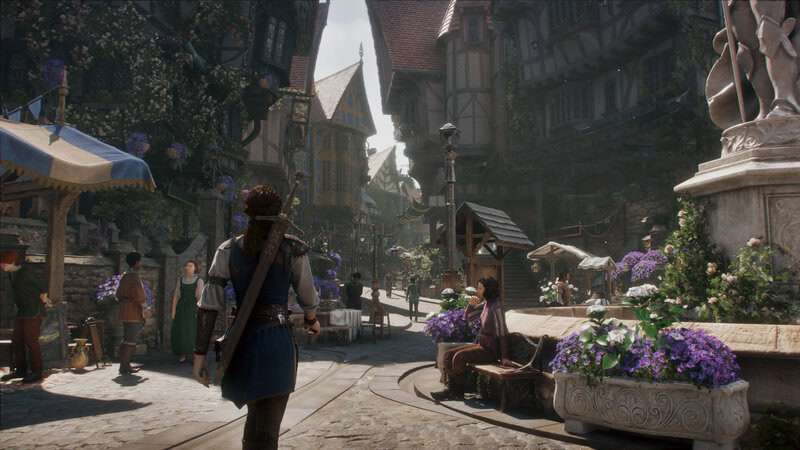
The evolution of RPGs in 2026 is being fueled by a fundamental shift in how stories are delivered within games. Instead of scripted missions and branching dialogue trees, developers are using procedural storytelling systems, which generate narrative endings depending on player actions.
This system differs significantly from traditional branching dialogue systems. Classic RPG narrative relies on written decision trees. Each option must be recorded, tested, and incorporated into a predetermined framework. While it provides tremendous narrative control, it raises scalability concerns—more options equals exponentially more writing.
Procedural storytelling systems address the issue by replacing fixed branching with rule-based generation. Rather than defining every possible outcome, developers provide limitations, emotional arcs, and behavioral logic. Rather than hard-coding every encounter, the system orchestrates narrative beats based on emergent logic, ensuring every playthrough is a unique, unrepeatable experience.
One of the most difficult issues is sustaining narrative consistency on a large scale. Without structure, procedural systems might yield conflicting or emotionally flat outcomes. To address this, developers employ methods such as memory persistence layers, modular story units, and emotional arc modeling to direct the flow of generated content.
AI and NPC Autonomy: Creating a Sense of Agency
In modern game design, AI and NPCs have emerged as critical foundations for immersion. Games like Fable and Nioh 3 (with their growing AI-driven design philosophical system) reflect a larger industry trend in which NPCs are no longer static, scripted characters repeating predictable lines. Instead, they react fluidly, adapt to context, and give the feeling of real intelligence behind their actions.
This transition is being driven by advancements in behavioral AI (Artificial Intelligence) systems that incorporate state machines, machine learning models, and procedural logic. Instead of depending only on prewritten scripts, NPCs now comprehend player actions in real time and respond precisely.
The emergence of emergent gameplay techniques is one of the main reasons these interactions seem more natural. Rather than manually planning every possible encounter, developers create interconnected systems of rules and actions. When numerous NPCs operate under these systems simultaneously, unforeseen problems arise. AI-driven procedural systems enable NPCs to respond to ambient changes and player action, resulting in more varied and unexpected gaming experiences.
However, this complexity introduces a significant technological challenge: performance and CPU optimization. Running hundreds of NPCs with independent logic systems, memory states, and decision-making processes may soon become computationally challenging.
Developers must carefully balance realism with efficiency by employing approaches such as level-of-detail (LOD) simulation for AI, in which distant NPCs utilize reduced logic while proximate NPCs use full behavioral systems. Some systems additionally update NPC decisions at intervals rather than continually, decreasing CPU burden while maintaining apparent realism.
Environmental Storytelling and Dynamic Ecosystems
The evolution of RPG design has transformed the way game worlds work. Modern games are transitioning from static landscapes to systems that respond to player action through environmental narrative and dynamic ecosystems.
For example, a once-thriving city may gradually empty as stores leave and structures degrade after economic collapse or may thrive with revitalization if the player preserves commerce or promotes local groups.
To support this level of complexity, developers rely primarily on procedural generation. Algorithms can generate topography, ecosystems, and environmental elements at scale, allowing for the efficient creation of enormous and diverse worlds.
However, procedural systems alone are insufficient. Without guidance, they may create environments that are inconsistent. Developers address this issue by integrating procedural tools with handcrafted design so that important plot elements are carefully constructed and procedural processes add diversity and richness. This makes the world feel both natural and deliberate.
Another important consideration is preserving narrative consistency. According to research, one of the most difficult issues in dynamic systems is maintaining consistency in the story while the world changes. If environmental changes aren’t represented in the story, players may feel detached. That is why synchronization is necessary. When ambient changes match conversation, missions, and character behavior, the experience becomes more immersive.
The Localization of Dynamic Content: A Developer Perspective

As modern RPGs adopt procedural storytelling, the localization of dynamic content in RPGs becomes more difficult. Unlike traditional games with set dialogue, procedural systems generate text in real time, combining variables to create hundreds of different phrase variations.
This creates a unique challenge: translators are no longer translating complete phrases, but fragments that must function in a variety of combinations. This might result in awkward or improper language if grammar rules are not properly followed throughout development.
Languages with complex grammar systems provide an extra layer of difficulty. In many circumstances, adjectives, nouns, and verbs must be gender, number, and case compatible. A simple phrase like “the hero defeated the enemy” can have several versions depending on who the hero is and how the sentence is structured.
There is also the issue of interactivity. Since players shape the story, text frequently lacks a defined structure or predicted order. This makes it difficult for translators to maintain consistency and meaning in all contexts.
To address these issues, developers must balance technology with linguistic design, building systems that can adapt to diverse languages while maintaining context and immersion. For studios looking to expand globally, partnering with SpeeQual Games can help ensure that your dynamic RPG content feels natural, polished, and culturally relevant in every language.
Scaling Innovation: Lessons for AA and Indie Developers
In 2026, the gap between AAA studios and smaller teams will be smaller than it was previously. While large productions like Fable can afford to invest considerably with complex technologies, AA and indie developers are learning how to scale innovation more effectively.
Rather than competing on scale, they compete on innovation and efficiency. AI-assisted processes have made procedural storytelling tools more accessible, which were previously reserved to large companies.
These technologies may produce quests, dialogue, and environment variants considerably faster, resulting in considerable production time savings. According to a study, AI may reduce labor time by more than half for the majority of tasks, allowing smaller teams to experiment with complex systems without requiring huge resources.
Game engines and middleware have also been more developer-friendly. Platforms such as Unity and Unreal Engine have built-in tools, visual programming, and asset ecosystems, making it easier to create responsive worlds. However, with all of these tools accessible, the greatest risk is attempting to accomplish too much.
Many games fail because they try to replicate every aspect of AAA games rather than developing a single core concept. The most successful indie games focus on a single unique mechanic—whether it’s procedural narrative, innovative combat, or a reactive world—and build everything around it.
Conclusion: The Future of Immersion in RPG Design
The evolution of RPGs is moving toward deeper interaction. Modern RPGs are evolving toward real-time storytelling systems, with AI-driven dialogue and dynamic environments. These innovations enable players to be involved in storylines that are not repeated but are uniquely formed by their actions.
As technology advances, the future of immersion in RPG design is in connectivity. Worlds will not only appear realistic; they will also feel aware, remembering action and reacting consistently. Ultimately, immersion will result from systems that function flawlessly together to create intensely personal experiences. RPGs are no longer just storylines to follow; they are worlds to live in, built entirely by the player action.