Audio is the atmospheric heartbeat of gaming; it is the invisible force that anchors players within a virtual reality. Immersive sound design helps to suspend disbelief and make virtual surroundings feel genuine.
However, using subtitles might detract the player from the whole experience. Players must divide their attention between reading text and playing, raising cognitive load and disrupting focus at vital points.
Game audio localization bridges this immersion gap. By providing professional dubbing, localized voice direction, and region-specific sound design, players can stay focused on the action. Instead of interpreting text, players can enjoy the game in their native language.
Curious about how game audio localization might help your game become an authentic global experience? Read the full article to learn more insights and strategies.
Voice-Over and Character Soul: Beyond Literal Reading
Game audio localization is often overlooked in the development process, despite its importance to global success. A game can have excellent visuals and mechanics, but if the voice acting in a local language is poor, player immersion breaks quickly.
Voice talents that fully understand the character they are portraying deliver the most impactful performances. Masterful voice talent doesn’t just recite lines; they breathe life into a character’s subtext, motives, and hidden vulnerabilities.
When the dialogue is localized into many languages, emotional comprehension becomes even more crucial. Vocal methods such as tone, breathing, and timing are very vital to this situation. A shaky voice can convey vulnerability, yet a long silence can portray loss more effectively than words ever could.
However, if voice acting in the local language is executed improperly, the consequences might be harmful. Flat delivery, awkward tempo, or the wrong emotional tone may rapidly disrupt immersion. Players may feel disconnected from the characters, and key plot points may lose their significance.
The Technical Mastery of Lip-Sync and Timing
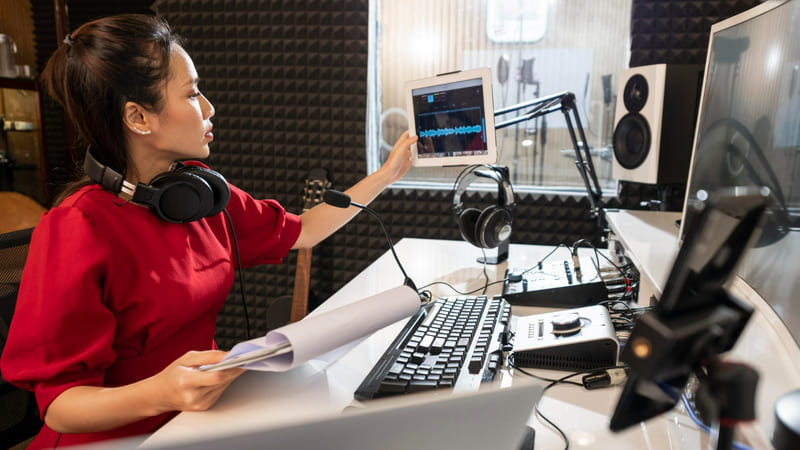
Lip-syncing in game audio localization is more than just a creative challenge; it’s also a technical issue. Game cinematics are based on fixed animation time frames. Each lip movement, face expression, and pause is pre-written to correspond to a source language. When the dialogue is localized, the new audio must maintain the same temporal structure.
Each language has its own rhythm; others are longer, others shorter, and some need a whole different pace. A sentence that fits flawlessly in English may take much longer in Thai or much shorter in Indonesian.
To address this challenge, localization teams deliberately alter the tempo rather than just translating word by word. Scripts are altered to keep meaning while adhering to the original animation timing. Voice talents are also instructed to modulate their tempo, breathing, and pauses so that emotional delivery remains genuine within time limits.
However, even with careful scripting and performance direction, perfect synchronization is extremely hard to accomplish manually. This is why artificial intelligence (AI) is becoming crucial. Cutting-edge AI now synchronizes viseme patterns with phonetic structures, ensuring that localized dialogue looks as natural as the original performance.
They may also dynamically change speech timing by stretching or compressing audio while maintaining natural tone. Some systems even create or change facial animation to better suit localized audio, eliminating the need for frame-by-frame manual editing. These tools enable studios to retain cinematic pace across different languages while lowering production time and costs.
Cultural Nuances in Audio: Accents, Dialects, and Slang
Using local dialects may greatly increase a character’s identity. Incorporating dialects properly into game dialogue helps portray real-world diversity and makes characters more realistic.
In a diverse country like Indonesia, different regions speak differently. For example, a character may speak with a Javanese or Sundanese accent to reflect their origins, providing players with a better feeling of identification and connection. This method is effective since dialects are inextricably linked to culture—they contain distinct phrases, tones, and social significance that make audiences feel more connected.
Slang provides an extra element of complexity. It changes quickly and varies widely among regions and cultures. A direct translation is rarely effective since slang frequently conveys cultural meaning beyond the literal words. Localization teams must carefully tailor these terms to ensure they appear natural and relevant to local players.
However, cultural awareness must also be considered. Dialects and slang may transmit important social and cultural messages. Using them incorrectly can reduce a poor impression. For example, faking an accent to make a character appear funny or naive may foster negative stereotypes.
Audio LQA: Testing the Sound in the Heat of Battle
Players expect dialogue in games to be clear, natural, and organized. This is exactly what game audio LQA (Localization Quality Assurance) is designed to solve. This process starts once the translation and voice recording are completed.
Testers play the game in real time to see how the audio works. They prioritize balance as one of the initial measures. Explosions, footsteps, or music may overshadow the speech, causing players to miss critical plot information or directions.
Another key aspect of audio LQA is ensuring that the correct audio plays at the right moment. Even small errors can disrupt immersion. A character speaking too early, too late, or in the incorrect intonation can be confusing or unnatural.
Common localization errors include audio triggering incorrectly, shutting off in the middle of a sentence, and subtitles or images that do not match. This is why LQA testers do more than just listen; they also play. They experience the game just like actual gamers and report anything that feels unusual, from unclear language to timing errors.
To deal with this complexity, many studios rely on specialist partners. SpeeQual Games provides specialized LQA services that address linguistic quality and voice-over performance. By integrating native testers with formal testing methods, they assist developers in detecting errors early on and providing a more immersive, seamless experience.
Spatial Audio and Immersion: Adapting for Local Players

Spatial audio, also known as 3D audio, is swiftly becoming one of the most popular techniques in modern game development. This technology simulates how humans hear sound in the actual world by arranging audio elements in three dimensions and surrounds the player with sound.
However, when games are translated for different markets, preserving that impression of depth becomes increasingly difficult. Game audio localization is more than just translating dialogue; it must also retain how the dialogue appears in the 3D audio environment.
Another important factor is recording quality. Modern players are increasingly relying on high-quality audio hardware, including surround sound systems, spatial audio headsets, and devices that enable technologies like Dolby Atmos.
These systems are intended to capture greater details such as direction, distance, and subtle environmental cues. Therefore, high-quality recording, including clean vocals, optimal microphone setups, and steady audio levels, is required to ensure that localized voices fit well in the 3D sound environment.
Conclusion: Sound as the Bridge to Global Success
Every aspect of game localization, ranging from voice acting and lip-sync to cultural sensitivity, LQA, and spatial audio makes one thing clear: audio is what elevates a game from functional to unforgettable. It conveys emotion, directs gameplay, and affects players’ connections with characters. When audio is correctly translated, players not only understand the game but also feel as if it was designed exclusively for them.
High-quality audio localization improves immersion and emotional engagement, allowing players to stay engaged in the game experience. However, when the audio fails—whether due to bad timing, poor delivery, or mismatched cues—the illusion is rapidly broken.
This is why audio should be handled as a strategic priority rather than just a technical step. In the global gaming market, where players seek authenticity and depth, audio serves as an unseen bridge across cultures, languages, and experiences, transforming local adaptations into truly global success.