Having your game translated, tested, and available in Indonesia is not the same as fulfilling compliance when evolving child-safety requirements.
Indonesia’s game industry is entering a more structured regulatory environment. The Indonesia Game Rating System (IGRS) provides a local framework for classifying games by age and content, while newer child-safety requirements under PP TUNAS extend compliance beyond content ratings to areas such as age assurance, child-data protection, parental consent, and platform feature design. Together, these developments signal a shift toward a more defined and accountable gaming ecosystem in Indonesia.
For publishers preparing to enter or expand in the Indonesian market, IGRS should therefore be treated as part of the localization and market-readiness process, rather than a final administrative step. Understanding how the system works, what information needs to be prepared, and how it connects with broader child-safety requirements can help teams build compliance into the game development and localization workflow from the start.
What Is the Indonesia Game Rating System? Understanding Indonesia Game Rating and Indonesia Game Classification
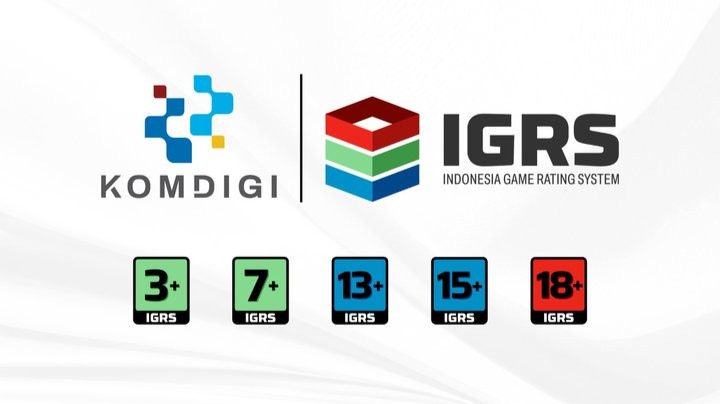
Under the Minister of Communication and Informatics Regulation No. 2 of 2024, now administered by the Ministry of Communication and Digital Affairs (Komdigi), electronic games distributed in Indonesia must be classified under the official IGRS framework at igrs.id. Fully applicable since January 2026, the system assigns age ratings (3+, 7+, 13+, 15+, 18+, or Refused Classification) based on factors such as violence, sexual content, language, drug references, and randomized monetization mechanics.
The compliance process relies on publisher self-assessment, but self-assessment does not guarantee automatic approval. Komdigi’s verification process can trigger further scrutiny, requiring publishers to clarify feature designs, provide extra documentation, or defend content that sits near a rating threshold.
This is why classification must be evaluated at the product level. The exact same title can yield vastly different regulatory outcomes based on its underlying mechanics. For example, a visually colorful mobile game may still face strict ratings if it incorporates randomized purchases, realistic player-versus-player combat, mature dialogue, or unmoderated social features accessible to younger audiences.
Why Indonesia Treats Game Classification as a Child Protection Measure
Komdigi has framed game classification as a child-protection measure against violence, pornography, and gambling-like mechanics. For publishers, this means compliance involves two distinct regulatory pillars: IGRS governs content suitability, while PP TUNAS (Government Regulation No. 17 of 2025) governs the digital environment surrounding that content.
Under PP TUNAS, operational requirements go beyond content ratings. Depending on product architecture, publishers may need to implement age-assurance tools, obtain parental consent, protect child data, set safe default settings, moderate social features, and adjust monetization flows.
A publisher’s duties depend on who operates the underlying infrastructure. Companies hosting their own account systems, chat networks, or payment gateways take on PP TUNAS’s platform-level obligations, such as age assurance, consent, and data protection, directly, on top of their IGRS content-rating requirements. Publishers distributing exclusively through third-party platforms like Steam or Roblox still own IGRS compliance for their game’s content, but share platform-level responsibility with whichever service operates the underlying accounts, chat, or payment systems.
What Publishers Should Know Before IGRS Verification Resumes
After the IGRS public platform launched in October 2025, major digital platforms began integrating its framework in early 2026, with Roblox introducing facial age estimation and Steam rolling out a mandatory developer content survey. Komdigi paused IGRS verification on 17 April 2026 to strengthen the system’s rating logic and data-security practices before continuing that rollout.
For publishers, the distinction that matters is simple: a rating displayed by any storefront’s own developer survey is not an official IGRS classification. Certification only exists once a title has cleared self-assessment and verification and received its certificate; treat anything short of that as provisional, however official it looks.
The same caution extends to unreleased content. Keep builds, screenshots, and scripts out of any platform’s verification flow until its data-security practices are confirmed, and route sensitive assets through channels your team controls directly. Both practices will matter more, not less, as additional platforms complete their own IGRS integration.
Current Reactivation Status
As of the latest public update reported on 10 August 2026, Komdigi is targeting IGRS reactivation before the end of 2026. The government has not announced a confirmed reactivation date.
ANTARA reported that the review covers more than a simple technical repair. The evaluation includes infrastructure, registration workflows, verification procedures, and the policies behind the system.
The process also involves the Ministry of Women’s Empowerment and Child Protection (KPPPA), the Indonesian Game Association, consumer and parent representatives, and the Ministry of Creative Economy.
Their involvement suggests that the reactivated system will be judged as part of a wider child-protection framework. Publishers should expect closer attention to both classification accuracy and the way games handle younger users.
PP TUNAS continues to apply during the IGRS pause, where its requirements are relevant to the publisher’s electronic system. Waiting for IGRS to return before starting age-assurance or data-protection work creates unnecessary launch risk.
What Publishers Should Do While IGRS Is Paused

Publishers can use the pause to resolve decisions that would otherwise delay a submission or regional release. The most useful preparation connects two areas: the content being classified and the systems through which children access the game.
Keep Indonesia Game Classification Documentation Updated
Start with the version of the game that Indonesian players actually receive. The self-assessment should reflect its dialogue, combat presentation, character designs, purchase flows, and live events. Screenshots and gameplay recordings can help explain details that a questionnaire alone may not capture, particularly when the classification depends on how a feature works in context.
For example, a description of “random rewards” leaves important questions unanswered. Publishers should document whether players pay to participate, what they can receive, and whether rewards can be traded or converted into something of monetary value. These details support a more informed assessment without assuming that every loot box operates in the same way.
Existing ESRB or PEGI ratings can provide useful background, but the Indonesian assessment needs its own supporting evidence. What counts as violent, sexual, or otherwise sensitive content is defined differently in each jurisdiction, so an ESRB or PEGI rating does not map directly onto an IGRS category; content cleared for a 17-year-old under one system may sit in a different age band or require adaptation entirely under IGRS.
Localization and product teams should review sensitive dialogue, alcohol references, sexual content, and violence together, identifying which elements could require adaptation. Where a regional change is appropriate, preparing alternative dialogue, visual assets, or feature settings early gives the team time to test their effect on gameplay and narrative consistency.
The documentation should also remain connected to the release process. A new seasonal event, character, or monetization feature can change the content players encounter after the original assessment. Recording those changes helps prevent the submission and the live build from drifting apart.
Review Age Verification Requirements for Games in Indonesia Alongside PP TUNAS
Content review should run alongside an assessment of the services surrounding the game. A publisher may distribute through a third-party storefront while still operating its own player accounts, chat, customer support, or purchasing features. The practical starting point is to establish who controls each interaction and who processes the child’s data.
Follow the player journey from registration through gameplay and spending. Identify how age is established, when parental or guardian consent is required, what information is collected, and which features become available to younger users. Legal and compliance teams can then determine the applicable PP TUNAS requirements, while product and engineering teams translate them into working controls.
Those controls need to make sense to the people using them. A consent screen can be accurately translated yet leave parents unclear about what they are authorizing. Purchase messaging can explain a price while obscuring how a randomized reward works. Native linguistic review and testing within the actual interface help uncover these gaps before they become part of the player experience.
Keep this work coordinated with the IGRS submission plan. Komdigi’s reported review includes infrastructure, registration, and policy, so publishers should check the confirmed requirements when the process resumes. Maintaining current evidence and clear internal ownership makes it easier to respond to changes without restarting the entire review.
Conclusion: Build Readiness Before IGRS Returns
The IGRS pause gives publishers an opportunity to examine how closely their classification documents match the game, and how well their services protect younger users. The reported target of reactivation before the end of 2026 remains a planning reference rather than a confirmed launch date. Meanwhile, the pause in verification does not itself suspend PP TUNAS obligations.
For publishers deciding where to begin, review one Indonesian release build alongside its content assessment and account journey. That exercise can reveal missing evidence, content requiring cultural review, or age and consent controls that need clearer ownership. Addressing those gaps early creates a stronger basis for the next submission.
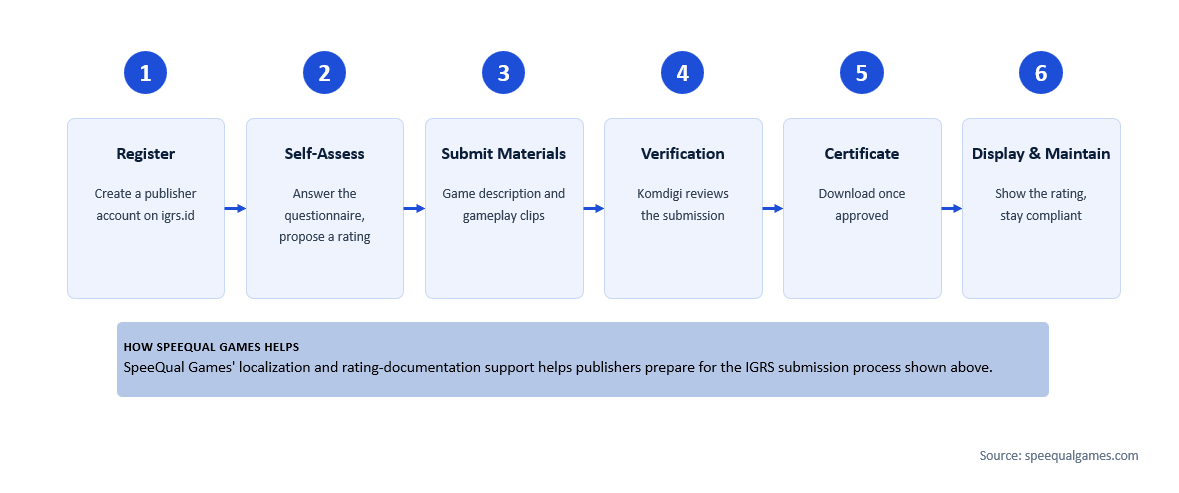
SpeeQual Games supports this preparation through game rating documentation and regional localization support, helping publishers communicate game content accurately and adapt sensitive material for local audiences while their legal and product teams coordinate the wider compliance requirements.

![Localization from day one helps games to connect with players throughout Southeast Asia.]](https://speequalgames.com/wp-content/uploads/2026/08/image-21.jpeg)
![Indonesia's top mobile games highlight trends for publishers to monitor in 2026.]](https://speequalgames.com/wp-content/uploads/2026/08/image-17.jpeg)