Southeast Asia counts an estimated 290 million gamers and about $6.6 billion in gaming revenue in 2025. Set revenue against player count, and the average revenue per user (ARPU) looks starkly low next to Western or East Asian markets with a fraction of the audience.
For monetization and product leads, that ratio is the hardest part of the region to model. High install numbers validate interest, retention holds, yet revenue forecasts still land below what the audience size implies. A revenue mix carried over from North America or Korea misses on conversion rates and total volume at once.
The gap does not mean players in Southeast Asia refuse to pay. This indicates that the dominant business model in this region was designed so that most players do not need to pay, and the revenue that is generated comes from a deliberate mix of advertising and in-app purchases rather than from a single source. Assembling that combination is a localization strategy problem as much as a pricing one.
The Scale of Free-to-Play’s Dominance in SEA
Free-to-play market share in the region is not a trend; it is the baseline. Free-to-play (F2P) accounted for 75.62% of the Southeast Asia gaming market in 2025, with gacha, season passes, and cosmetic bundles anchoring spend, far ahead of subscription or pay-to-play models. For players, the purchase decision never stands between them and the game. It sits inside it, reached only after they determine the game is worth their money. For a publisher, this shifts the entire monetization strategy to the far side of the install.
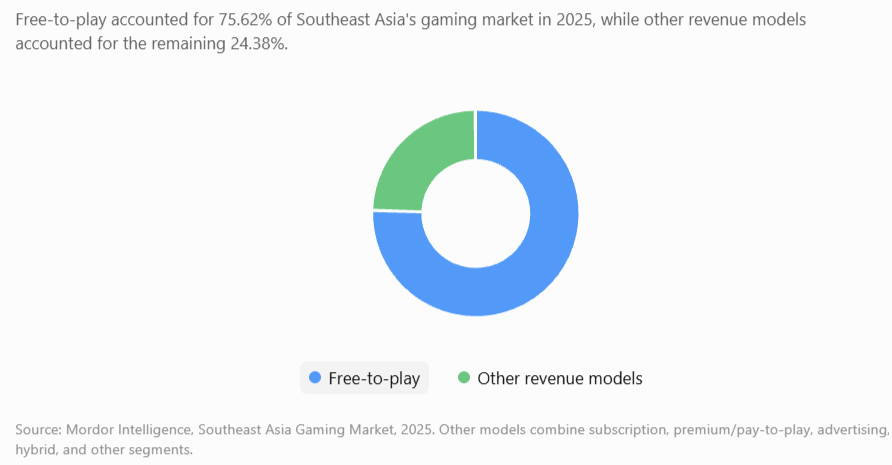
Platform choice reinforces the model. Mobile gaming accounts for roughly 70% of total gaming revenue in Southeast Asia, reflecting how much of the region came online through a smartphone rather than a console or PC. Because mobile sessions are short and frequent, free-to-play economics are built around these daily habit, which is why regional monetization planning starts with session design rather than a price list.
Scale here is defined by total earnings, not just player count. Free Fire and PUBG Mobile anchor the region’s mobile market, with Free Fire alone generating $358 million in annual revenue. Titles at that size confirm the model collects real revenue, not just installs.
That scale hides the number explaining why the model had to be free-to-play at all.
Why Pure Paid Models Don’t Work Here: The ARPU Reality
![SEA’s lower ARPU makes free-to-play and rewarded ads more accessible than paid games.]](https://speequalgames.com/wp-content/uploads/2026/09/image-52-1024x683.jpeg)
Against a player base that size, regional mobile game revenue is estimated at roughly $4.6 billion on an Android-first, with ARPU sitting below $15 in most markets, a fraction of East Asia mature benchmarks like South Korea. ARPU at that level cannot support an upfront price tag. A paid title asks players to value a game before playing it, whereas Southeast Asian prefer to evaluate games after trying them. That same player who will not pre-pay will happily watch a rewarded ad, trading attention rather than cash.
That behavior reshapes the revenue split. Because in-app purchase conversion is low, advertising carries a larger share of revenue, making hybrid-casual and ad-led models fit the region better than a Western-style premium strategy. Benchmarks put a number on it: the optimal mix for Asia-Pacific (excluding China) sits at 50% to 60% in-app purchases and 40% to 50% ads, against 70% and 30% for North America and Western Europe.
For product leads, this gap serves as a practical warning. An F2P game monetization plan imported from a Western profit and loss (P&L) misallocates roughly 20 points of expected revenue away from advertising. The resulting shortfall usually exposes an ad stack that no one properly staffed or integrated. A game monetization strategy decided before launch, rather than corrected in live ops, keeps that gap from opening.
Since a low ARPU forces publishers to blend revenue sources, the question is which part of the blend actually produces the money.
Where the Real Money Actually Comes From: The Hybrid-Casual Math
Hybrid-casual game monetization is arithmetic rather than philosophy. Ads monetize the 95% who will never pay, in-app purchase captures incremental revenue from the 5% who will, and the combined lifetime value (LTV) justifies the user acquisition cost. At regional ARPU levels, neither revenue stream can fund the game alone; LTV only clears acquisition costs when both halves are counted.
Vietnam demonstrates this shift in real time. Long a hyper-casual powerhouse, the country led the world in mobile game downloads in 2024 with 6.1 billion installs, yet generated only about $430 million in revenue, and ARPU sits at roughly $12, well below the global average. Download leadership without matching ARPU is exactly the condition the hybrid model was built to solve, and Vietnam’s development scene is actively pivoting to hybrid-casual to close that gap: in-app purchase revenue in the market grew 65% as studios moved from a pure ad-driven model toward hybrid economies. Vietnamese publishers are not adding in-game purchases because players suddenly developed spending habits; they’re adding them because the paying minority has to be captured somewhere the ad-only model was leaving on the table.
Layering monetization like this has become standard architecture. Integrating advertisements, subscriptions, and microtransactions into a single revenue structure extends player lifetime value long after a single transactional relationship would have ended.
Once the architecture is well documented, the next task is making the offer inside it feel local rather than imported, and that’s where the real challenge lies.
Why Culturally-Tuned Monetization Is What Actually Converts the 5%
![Culturally-tuned monetization helps games turn more SEA players into paying customers.]](https://speequalgames.com/wp-content/uploads/2026/09/image-51.jpeg)
A correct revenue structure sets the ceiling: presentation decides how much of it a title actually reaches. Players are more inclined to spend when deals, offers, and store items speak in their language, tone, and cultural context. Regional localization at this level goes far beyond translating a storefront page. It dictates how pricing is displayed, how rewards are structured, and how seasonal events align with local purchasing habits.
The failure mode is quiet. In-game purchases can feel obtrusive when commercialization fails to incorporate cultural context, while games that prioritize context-based localization are more likely to increase player loyalty and revenue. A player who finds an offer intrusive does not file a ticket; they dismiss the panel and keep playing for free, and the dashboard reads them as someone who never intended to convert.
The same applies to price itself. Regional pricing and locally familiar payment options are part of how storefronts built durable positions across the region, and the same logic applies to an in-game shop, where local currency framing, bundle size, and event timing decide whether an offer reads as fair.
Two titles using identical hybrid models can convert differently in the same market. The difference lies in how relevant the offer feels to a local player, not the mechanics behind it. This is where game marketing and monetization converge, and it serves as a reliable test for any prospective publishing partner: ask them how their localization strategy adapts the offer itself, not just how they tune the ads-to-IAP ratio.
Conclusion: Bridge the Gap Between Downloads and Monetization in SEA
Free-to-play dominance in Southeast Asia is not an accident of taste. It is a response to a very large player base and an ARPU that cannot support a paid gate, and dominance alone does not guarantee the money arrives.
Revenue comes from two parts: advertising that monetizes the majority who always play for free and in-app purchases that feel genuinely relevant to the players willing to pay. The second gets far less attention than the ads-to-IAP ratio it depends on, though it decides how much of that ratio materializes.
SpeeQual Games brings 24+ years of localization expertise and 10+ years of gaming specialization to that challenge, tuning a monetization plan’s language, tone, and value presentation to what each Southeast Asian market actually responds to, from how a price is shown to how seasonal rewards are built. If your next title is scaling into the region, our marketing and monetization localization team is where that localization strategy starts. Talk to us about turning regional reach into revenue instead of downloads.
![Popular Roblox games highlighting the platform’s growing influence.]](https://speequalgames.com/wp-content/uploads/2026/09/image-56.jpeg)
![Humor in games is conveyed through words, timing, and cultural context.]](https://speequalgames.com/wp-content/uploads/2026/09/image-48.jpeg)
![Presidential Regulation 19/2024 focuses on national gaming regulations rather than content ratings.]](https://speequalgames.com/wp-content/uploads/2026/09/image-45.jpeg)