The use of artificial intelligence is growing in prominence in the dynamic world of video games. AI is reshaping immersive experiences through smart game engines that adapt to gameplay and NPCs that remember player choices, making them feel more alive.
AI-based localization and translation services are emerging to meet growing global demand. As games become more multilingual, players can now connect seamlessly in their native tongues and cultural contexts.
This situation demonstrates that we are moving beyond simple gaming and into immersive worlds that interact with players in their local languages, adapt to human preferences, and encourage deeper cross-border social interactions.
Localization and translation have grown more and more important in games these days. This process used to be labor-intensive and time-consuming, but with the development of increasingly sophisticated AI systems, it can now be sped up with neural engines, context-aware natural language processing (NLP), and real-time text or speech adaptation.
This change reduces cultural and background friction while enabling developers to provide millions of gamers worldwide with engaging experiences. In addition to playing in distinct ways, we also communicate in different languages, which makes it possible to create cross-cultural communities where communication is not hampered by language or cultural context.
In this article, we invite you to discover more about how AI is altering and serving as a tool to ease the translation and localization process in game development processes, resulting in engagement and immersion.
A Quick Look Back: From Dumb Bots to Smart Worlds
Developers of early video games in the 1970s and 1980s deployed what are now known as “bots,” which are an assortment of basic rules and movement loops, to simulate obstacles. With AI, developers are finding new ways to enhance storytelling, realism, and player personalization.
Game world-building was made possible by these early systems. Game universes changed into more “alive” systems as technology advanced in the 1990s. NPCs, or side characters, began employing behavioral models that gave them restricted mobility and patrol capabilities. Even while the ‘bots’ still seemed rigid, they were now more intelligent and engaging.
As the internet and digital technologies became more widely used in the 2000s, the gaming industry started to change by developing more dynamic gameplay systems. Artificial intelligence technology was implemented more massively in the game industry at this time.
The advent of games with more intricate world-building, more customized gameplay, and more unpredictable NPCs in the middle of the 2010s further increased the popularity of AI. The transition from ‘dumb bots’ to ‘intelligent universes’ is underway as AI techniques advance.
Future games will probably feature multilingual NPCs, surroundings that change according to the player’s actions, and experiences where every player has a genuinely unique experience.
Beyond Gameplay: AI Behind the Scenes
Artificial intelligence is subtly changing the way games are made, maintained, and improved behind the scenes. From automated testing to design assistance and behavior prediction, developers now rely on AI to speed up game production and enhance player experiences.
1. Testing Automation
One of the most challenging tasks in the game production process is game quality assurance (QA), which includes testing games hundreds of times, fixing problems, monitoring performance across platforms, and more.
With automated testing tools that use scripts and bots to run builds, test mechanics to the limit, identify crashes, and highlight performance regressions, artificial intelligence is altering this dynamic. By examining gameplay patterns and map data, this system can identify trouble spots more quickly than human labor.
2. Game Design Support
AI has started to integrate into creative and design processes in addition to evaluating, enabling writer teams, game designers, and art directors to collaborate more effectively.
A study claims that generative AI tools are currently being utilized for procedural content production as well as idea development, concept art, and dialogue prototypes.
AI can produce preliminary versions of level layouts or NPC dialogue, which designers can later polish and improve. This workflow enables faster and more efficient iteration.
3. Predictive Analytics
Predictive analytics expands the influence of AI into real development, deployment, and business decision-making, whereas testing automation and design support mostly function during the development process.
In the context of gaming, this entails examining player data streams, such as session lengths, churn indicators, in-game purchases, and behavior patterns, in order to supply input for models that forecast the user’s subsequent behaviors.
Additionally, predictive analytics aids in marketing optimization, matchmaking fairness, and intelligent recommendation engines that tailor levels and items for players.
How AI Is Rewriting the Rules of Gameplay
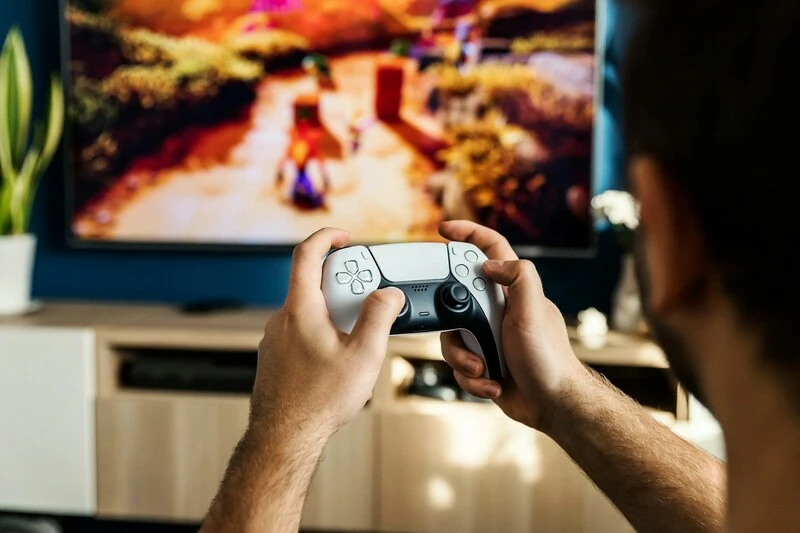
Games are no longer constrained by strict scripts or recurring patterns as AI enables more immersive experiences. This chapter explores four key ways AI has transformed gaming, turning passive world-building into active, engaging gameplay.
1. Smarter NPCs
NPCs are essentially automatons—scripts that are activated by player activities and programmed to respond in predictable ways. NPCs now use machine learning, NLP, and memory models to react dynamically, remember player actions, and adjust dialogue or strategy.
Studios like Ubisoft and Nvidia use AI to create more dynamic, responsive NPCs that interact in real time. These characters now react uniquely to player behavior, from kindness to hostility, enabling personalized interactions.
2. Procedural World Generation
By using AI, we may now witness the creation of immense game worlds that are contextually meaningful. It is possible for generative models to produce environments, terrains, object placements, and even ecosystems that react to player choices.
Rather than a static and repetitious setting, players can now engage with an evolving one. For instance, AI-driven systems can generate maps that meet design goals and evolve based on player actions, like harsher terrain after destructive behavior.
Major gaming companies such as Tencent and Zynga use AI to make world-building more complicated in order to forecast player behavior and retain engagement with specialized objectives, events, offers, and challenges.
3. Dynamic Storylines
AI-powered narrative systems—stories that are personalized and able to react to player activities rather than requiring players to follow preset routes—are now replacing linear narratives and simple branching paths.
AI generates customized missions, characters, and world events after analyzing choices, playstyle, and even player voices. This transforms the narrative into an active partner: players not only follow the story but also actively contribute to developing it.
4. AI-Powered Voice & Dialogue
One of the most difficult or confining aspects of game development is the process of integrating dialogue and voiceovers. However, AI transformation is accelerating this time-consuming process.
Natural language models and speech synthesis let games generate dynamic dialogue, process voice input, and respond instantly. Characters can adjust tone, speak uniquely, and react to players’ voices in real time.
Where AI Meets Language: Gaming Translation Services

As the gaming industry grows, developers face new challenges—creating experiences for millions across different languages and cultures instead of just one region. To reach a global audience, games must be translated accurately, quickly, and culturally sensitively. Interface text, dialogue, menus, and local jokes must feel natural so players aren’t pulled out of the game by language barriers.
Thankfully, artificial intelligence has become a potent ally in this international struggle. Modern AI translation can automatically handle large text volumes, preserve tone, adapt metadata, and integrate with localization workflows.
Platforms built for game translation now offer context-aware engines that understand game terms, character traits, UI limits, and each genre’s unique style. However, AI still can’t fully replace human translators in handling the deeper context of game localization.
There are many regional idioms, jokes, slang, cultural allusions, distinctive character voices, and interactive text that is contingent on time and personality in the gaming industry.
Despite being extremely quick and constantly evolving, machine translation systems still have trouble grasping humor, context, tone consistency, and the subtleties of cultural expression.
AI, Culture, and Global Gaming Connection
Artificial intelligence is quickly permeating the gaming industry, and its impact extends beyond the actual game mechanics.
This shift has an impact on players’ interactions with games as well as their interactions with other players across linguistic, cultural, and national boundaries. Let’s examine how AI is changing the game industry globally from a cultural and societal perspective.
1. Cultural Representation Through AI
AI tools are increasingly used to create immersive stories, smart dialogue, and localization, expanding games’ global reach. Through procedural storytelling and automation, developers can build vast, personalized worlds that cross regional boundaries.
However, complicated cultural nuances are frequently a barrier since AI cannot fully comprehend regional vocabulary, tone, and local jokes. Nonetheless, AI can operate as a bridge for cross-cultural communication, expediting translation and localization, maintaining character tone, and ensuring that more players globally have a more immersive experience.
This allows players across countries and cultures to interact and build intriguing communities without losing the nuances of the game’s story.
2. AI and the Social Fabric of Online Gaming
AI also has a huge impact on how players interact with each other. In online and multiplayer games, AI-powered systems may monitor discussion, detect hate speech, and report toxic actions in real time.
This contributes to a safer environment in which players of diverse ethnicities and ages can interact without fear of harassment. Beyond moderation, AI shapes in-game social dynamics by matching players, suggesting connections, and adjusting goals based on interaction styles.
AI contributes to the development of more inclusive and positive communities by evaluating how players act and communicate.
The Challenges: When AI Gets It Wrong
Previously, we covered the various impacts and benefits of utilizing AI to help make games more dynamic and engaging. Although AI has immense potential, it does not come without risks.
Player trust may be affected by issues ranging from minor glitches to major failures. In this section, we are going to look at the main obstacles in AI-based game development.
1. Uncanny NPCs and Flawed AI Behavior
Character behavior is among the most obvious domains in which AI adoption may fall short. It is assumed that NPCs will feel alive; however, this illusion is broken when AI-generated dialogue or behaviors fall short.
Immersion can be ruined by faulty AI behavior, whether it’s NPCs walking through walls, saying the same thing repeatedly, or responding incorrectly.
A greater risk is when ‘smart’ AI systems overreact, as seen in situations when difficulty spikes seem unfair or when NPCs misread player actions and respond in an undesirable way.
2. Localization Errors and Tone Mismatches
AI-powered translation systems are utilized to localize a lot of game content since games today are being generated all over the world.
AI occasionally still has trouble understanding slang, comedy, and cultural context, despite machine translation being almost flawless. Misunderstandings resulting from these problems can drive away global audiences.
3. Bias in AI-Generated Content
AI systems learn from data. If the data is biased, then so will the results. In gaming, this can have an impact on character design, dialogue, setting construction, and even matchmaking systems.
This raises severe concerns about cultural insensitivity and a lack of diversity, particularly when development teams depend too heavily on automation without human supervision.
The Future of AI in Gaming
Every facet of games is expected to integrate AI systems more deeply: conversational NPCs, dynamic storylines, an increase in multilingual players, and real-time translation.
More AI training tools, immersive voice interfaces, and a trend toward games that are not only worldwide but also naturally bilingual, culturally aware, and socially linked are all things we may expect to see in the future. Additionally, localization and translation will become integral components of game architecture rather than an afterthought.
In order to create game systems that represent such preferences across various languages and cultures, developers will use AI agents to examine how players talk, play, and interact. Among the various potentials of AI, we recognize that AI in the gaming industry is a strong tool—but it is not a magical solution.
If AI is implemented without human supervision, it may create errors, biases, cultural insensitivity, or alienating experiences for gamers. Recognizing the problems and hazards associated with utilizing artificial intelligence is a prudent step toward creating improved and more inclusive user experiences as the gaming industry continues to widely adopt it.
After all, excellent games are more than just technically and artistically advanced; they also evoke emotions, raise cultural awareness, and feel real.