
In today’s gaming industry, the art of storytelling in games has become as important as graphics and gameplay. Well-crafted storytelling may capture and emotionally engage players in the game. Branching narratives, hidden backstories, and numerous endings are all storytelling strategies that motivate players to take alternate pathways, discover secrets, and replay the gameplay. Narrative-driven games, from smaller titles to AAA blockbusters, are altering the future of the gaming industry by making it more interactive. Players now prefer complex characters, a setting that feels real, and a developing narrative. In this article, we will explore the reason why storytelling is so crucial in modern games and how key elements can enhance the player experience.
From Pixels to Plots: How Game Storytelling Has Evolved
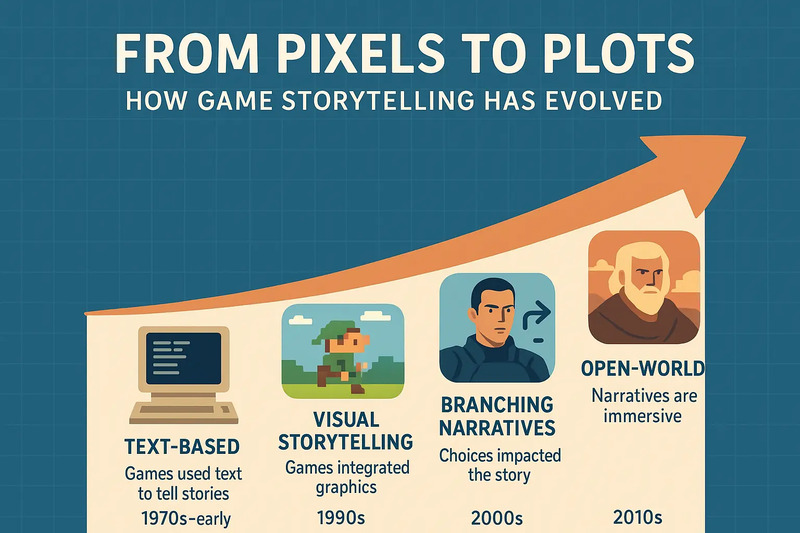
From pixelated graphics like the era of Pong and Space Invaders, video games have developed into intricate storylines that arouse feelings, as seen in many modern titles. We will examine narrative strategies and their effects on the player experience as we explore the dynamic evolution of game storytelling.
Text-Based Games Introduction (1970s–early 1990s)
Due to technology constraints, early video games still used text-based storylines about fifty years ago. Early RPGs, such as Zork, stimulated players’ imaginations and established the groundwork for narrative-focused experiences by immersing them in the worlds that were portrayed in written text.
The Emergence of Visual Storytelling (1990s)
As technology has advanced, the complexity of game storytelling has also increased. Games incorporating visual storytelling, such as Final Fantasy VII and The Legend of Zelda: Ocarina of Time, began to emerge in the 1990s. Players have been introduced to more detailed settings and world-building with varied characters throughout these games. The shift from text-based games to visual storytelling during this era became a significant step toward more immersive game narratives.
Branching Narratives and Player Agency (2000s)
Games from this era, such as Mass Effect 1 and Star Wars: Knights of the Old Republic, offered several storylines and different endings according to the choices made by the player. This era paved the way for game developers to enhance replay features and player agency.
Open-World Storytelling (2010s-Now)
Video game narratives have expanded in diversity from the 2010s to the present, covering a wide range of genres and styles. The shift toward player-driven storytelling was signaled by the popularity of open-world video games. Games like The Last of Us and The Witcher 3: Wild Hunt use voice acting and sophisticated graphics to portray narratives in a cinematic style that evokes strong emotions.
The Core Elements of Game Storytelling
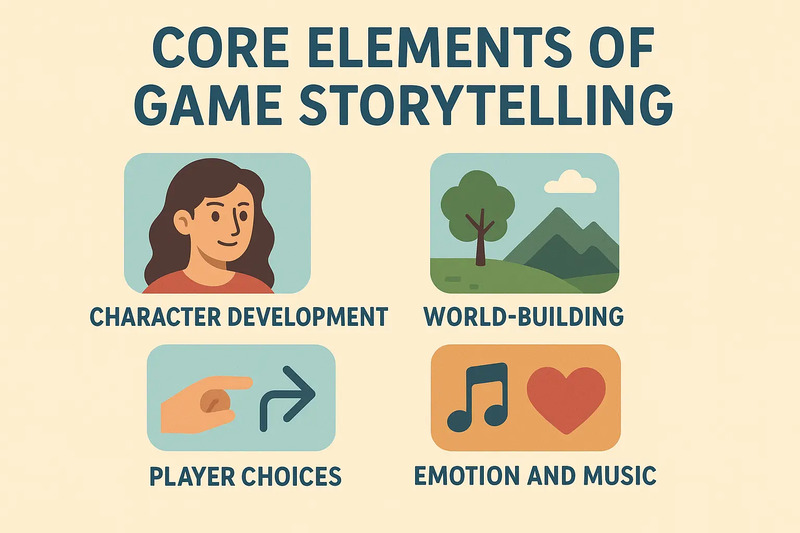
In contrast to books or movies, video games allow players to engage with the story and take part in it instead of just watching it. Game developers must skillfully integrate a number of interconnected elements to develop captivating game narratives.
1. Character Development
Character development in game storytelling can enhance the narrative and engage players emotionally. Strong characters with depth and development serve as the emotional core of a game’s narrative, making it memorable and impactful, even attracting other players to play the game. Protagonists like Ellie in The Last of Us, Kratos in God of War, or Arthur Morgan in Red Dead Redemption 2 demonstrate how deep character development enriches the overall player experience.
2. World-Building and Setting
World-building and narrative design are crucial in storytelling-based games—both are capable of shaping emotional depth, conflict, and player immersion. Players are encouraged to interact with the world outside the main plot by the lore-filled, detailed world-building, which enables them to discover hidden secrets and hear NPCs’ dialogue. As an example, The Elder Scrolls V: Skyrim offers players a diverse range of living creatures, a setting rich with myths, ancient ruins, and political turmoil.
3. Player Agency and Choice
In narrative-based games, player agency and choice are not just features—they are storytelling elements. These elements allow players to take charge of the story, give actions more significance, and alter the overall experience. For example, The Butterfly Effect system in the horror game Until Dawn, every decision that players make affects the game’s plot and influences everything from character relationships to who survives or dies.
4. Emotion and Music
The quickest way to establish a scene’s emotional atmosphere is with music. Music has the power to immerse players in the game setting without the use of words. Music can serve as more than just a soundtrack; it can also enhance immersion, allowing players to fully experience each character’s feelings. For example, each character (Kara, Markus, and Connor) in Detroit: Become Human has an individual musical theme that reflects their unique personalities, journeys, and emotional changes.
The Role of Technology in Modern Game Storytelling
Certainly, technology has a significant influence on how storytelling is conveyed in video games—not merely as a tool to make graphics more beautiful or control mechanics smoother. Here is an overview of the role of technology in storytelling in modern games.
1. Advanced Graphics & Animation
The development of photorealistic settings and more compelling characters is made possible by modern graphics tools like Unreal Engine 5 and Unity HDRP. With the support of these visual tools, developers may convey emotions in unique ways–they are able to create facial animations that allow characters to express emotions subtly.
2. Adaptive Narratives and Branching Choices
The technology system enables branching dialogue, making each player’s choices important as it significantly affects the storyline. This system allows developers to create many possibilities and offer various narrative plots.
3. High Fidelity of Visual and Audio Design
More sophisticated graphics, dramatic lighting, realistic reflections and shadows, high-quality spatial audio, and voice acting are all made possible by technology’s influence on the evolution of modern game storytelling. It improves the emotional atmosphere and amplifies the impact of the game’s storyline.
4. Artificial Intelligence (AI) in NPCs Behavior
Since AI technology has advanced, non-player characters (NPCs) can respond dynamically to player choices, making the gaming world more responsive and realistic. In Red Dead Redemption 2, NPCs are able to remember the player’s actions, welcoming the player based on their actions, and even have their own lives.
Storytelling Across Game Genres
Which game genres are your top picks? Storytelling in games can be conveyed in a very different way depending on whether you prefer playing large-scale role-playing games or competing with your friends online. Different game genres approach storytelling in unique ways:
1. Role-Playing Games (RPGs)
Captivating storylines, vast world-building, and multiple player-choices storylines are characteristic of role-playing games. Players can interact emotionally and make moral decisions when playing this genre, which makes them feel like the protagonists of their own story. Character development, intricate lore, and branching dialogue trees that affect the story’s ending are also prevalent in these genres.
2. Adventure and Exploration Games
Character-driven stories, puzzle solving, and atmospheric narrative are typically the main focuses of adventure games. Unlike RPGs, adventure games usually have a fixed plot that players must stick within the gameplay. Like Firewatch, for example, which emphasizes first-person exploration with a storyline that is entirely driven through character’s dialogue.
3. Multiplayer Games
Storytelling in multiplayer games such as Among Us, Call of Duty: Warzone, and Fortnite often emerges naturally and unpredictably. These games may lack a typical storyline in favor of player-driven storytelling, social dynamics, competitiveness, as well as lore presented through world-building, items, or cinematics.
Challenges and Future Trends in Game Storytelling
As we all know, games have evolved from simple text boxes to sophisticated storylines with branching dialogue options. This evolution undoubtedly brings many challenges—and new opportunities.
Challenges in Game Storytelling
1. Balancing Story and Gameplay
Developers frequently encounter the difficulty of integrating narrative into games without interfering with gameplay. Narrative-driven games may feel like movies, which might detract from the player experience. Conversely, a game with little narrative can make the gameplay feel hollow.
2. Maintaining Player Agency
It takes a tremendous amount of money and manpower to provide players the chance to select branching dialogues that have the possibility of significantly shift the overall story. Although player freedom increases engagement, it can also impact the emotional effect and the story.
3. Technical Limitations
Technical and financial limitations may be exceeded when developing branching narratives, realistic AI dialogue, or extensive open-world plots. Smaller indie studios frequently find it difficult to adopt advanced storytelling systems without making major financial concessions, in contrast to larger studios.
4. Player Expectations
Players increasingly prefer emotional depth, immersive realism, and branching plots as narrative techniques in today’s games advance, which is starting to raise the standard for all narrative-driven games.
Future Trends in Game Storytelling
1. Virtual Reality and Immersive Narratives
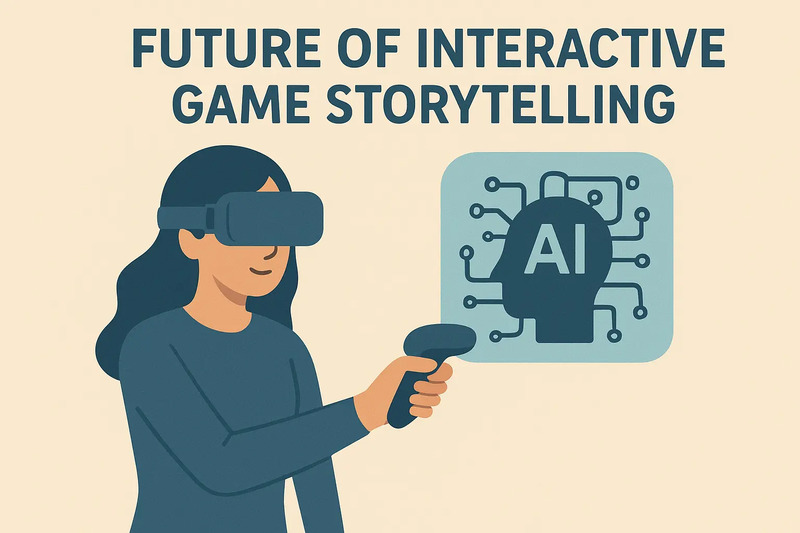
With the growing popularity of virtual reality (VR) and augmented reality (AR), gaming narratives appear to have a promising future. The latest developments in technology provide fascinating prospects for immersive storytelling.
2. Interactive Storytelling with Haptics and Biometrics
The complexities of modern technology enables a game to utilize player biometrics (heart rate, emotional state), voice recognition, or even haptic feedback to shape the story line.
3. Transmedia Storytelling
Storytelling will become more prevalent outside of video games; a title can even be turned into a web series, comic book, or TV show that provides deeper background and fosters community engagement. League of Legends accomplishes it by extending its universe with Arcane, a Netflix series that explores into the backstories of each character.
4. AI-Driven Narrative Systems
AI is being used extensively in future games to create dialogue, quests, and character responses in real time, delivering incredibly dynamic and customized narratives.
Conclusion
From pixelated graphics and traditional narratives to emotionally charged experiences driven by player choices, storytelling in games has undergone an extensive journey. Despite the importance of sound design, visuals, and game mechanics, the art of game storytelling frequently makes games memorable. The art of storytelling in video games allows the player to feel emotionally invested in every move, every setting, and every moment. Whether it is an epic saga or an intensive adventurous gameplay, an intriguing narrative can generate an experience that lingers with players long after the game is over.