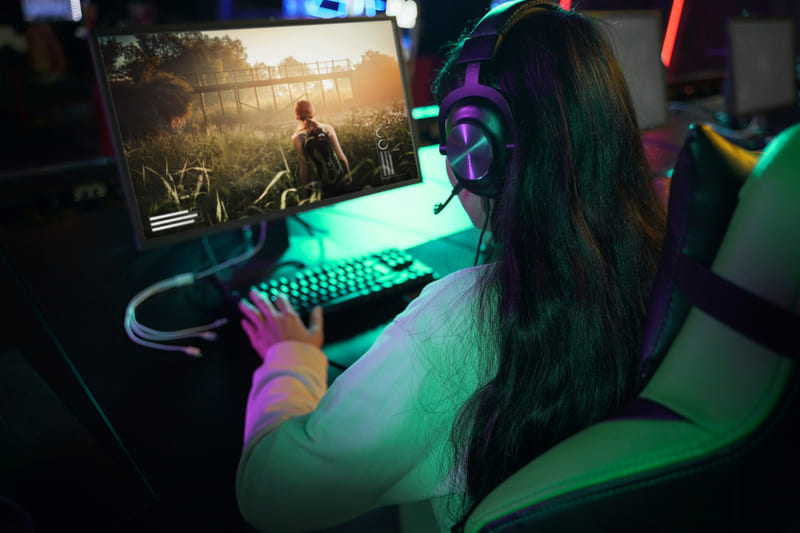
In today’s gaming industry, artificial intelligence (AI) has evolved from a background algorithm into a vital component that defines and elevates modern gameplay. Games used to be created with static systems that only reacted to predefined outcomes and coded rules.
These days, artificial intelligence (AI) turns games into adaptable ecosystems that can learn, change, and react emotionally to players.
The distinction between systems and emotions becomes blurry as a result of this transformation, which represents an enormous shift.
In a dynamic digital environment that can comprehend and react to their decisions, players are no longer merely participants but also decision-makers.
In the modern era, games have become “digital organisms” rather than mere “entertainment products. These AI-powered experiences can create emotional connections, anticipate player intentions, and personalize narratives—features that once seemed impossible in technology.
The future of gaming is more organic, intelligent, and emotionally resonant than ever, as AI continues to merge with creative design, storytelling, and real-time decision-making.
In this article, we’re going to look further at how AI is integrated into game development in relation to the AI revolution that has the potential to completely change how games interact, the rise of players who are developing alongside technological advances, and the expanding role of AI in bridging linguistic and cultural barriers across the world.
The Quiet Revolution Behind the Screen
Today’s game worlds are no longer painted solely by human imagination—they are generated, replicated, and evolved through artificial intelligence. The AI revolution has quietly redefined the norms of world-building in games, altering how developers build ecosystems.
Yet as digital worlds grow more dynamic, new paradoxes begin to surface. As AI technology advances, new concerns regarding the role of human creativity arise.
Subtle Shift: From Artist to Designer of Intelligence
The first thing you’ll notice when you enter a modern game studio is that it feels more like an intelligence lab than an art workshop. Developers no longer manually construct every road or building; instead, the creative process has evolved into a continuous experiment.
Rather, they create generative procedural models that learn how to create cities, forests, and skies, as well as systems that train AI to replicate player behavior.
AI can now add realistic aspects to world-building using machine learning, such as NPCs with unique memories, climate-adaptive city simulations, and lighting that changes to simulated weather conditions.
As artificial intelligence improves its ability to generate narratives and emotional depth, the human role in creativity becomes increasingly abstract. The influence of AI in the modern gaming world is blurring the distinction between invention and automation.
Universes that were formerly created with sketches and scripts are now more realistic due to algorithms that can adapt and improvise. However, the core of human creativity is irreplaceable. AI may simulate emotions, but it cannot experience them.
A New Kind of Player Emerges

Source: Unsplash.com
Players are evolving alongside the gaming industry itself. Today, players are able to collaborate with AI instead of being restricted to a predetermined storyline. The interactive and collaborative nature of gaming is made possible by artificial intelligence.
Modern gamers are no longer mere consumers—they create, modify, and even influence the systems that govern their virtual worlds.
Players are becoming more involved in world-building and creating narratives using AI-enhanced tools, modification platforms, and dynamic in-game interactions. Real-time game world reconstruction allows them to add features and improvements that would not have been possible without developer intervention.
The Rise of The AI-Enhanced Player
AI has enabled gamers to push the boundaries of traditional gameplay. Thanks to procedural content generation, intelligent NPCs, and adaptive narratives, players can now explore worlds that respond uniquely to their every action.
The modding community leverages AI technologies to develop new levels, characters, and mechanisms more rapidly and intricately than ever.
In certain situations, AI-powered game engines learn from player behavior, resulting in environments that grow dynamically based on collective input. TThis evolution is reshaping the very concept of play itself.
Every choice, adjustment, or contribution creates a positive feedback loop that allows the AI to learn from the players.
The Cultural Impact: Redefining Modern Gaming
Today’s gaming community emphasizes sharing knowledge, collaborative creation, and experimenting with AI-driven systems. Modern gamers thrive on freedom and influence, turning passive interaction into meaningful participation.
AI’s function is becoming more and more innovative, enabling players to take charge of the gaming experience and redefine what might be featured in a game.
When Culture Meets Algorithm
A new frontier where culture and algorithms collide has formed in the constantly evolving industry of game development. In today’s digital age, artificial intelligence learns from massive global datasets to generate realistic systems, characters, and stories.
But in between all of this technical advancement, an important paradox emerges: AI can learn from data—but culture transcends it.
The Intersection of Culture and Data Machine
In order to forecast content that players would like to consume, AI systems analyze linguistic trends, user behavior, and big databases. But culture is unpredictable. Culture resists fixed rules and thrives on paradoxes. A local joke that amuses gamers in Tokyo, for instance, can be confusing to players in Jakarta.
This is the paradox of AI-driven creativity: while machines become smarter, they struggle to grasp humanity’s intangible nuances. While data is universally applicable, culture emphasizes individual uniqueness.
AI as a Cultural Interpreter, Not a Replacement
The future of game development relies on AI’s ability to acquire cultural emotions, not just linguistic accuracy. Developers are starting to employ AI as a cultural interpreter to assist them comprehend context in various countries.
By assessing players’ tone, rhythm, and sentiment, AI can identify cultural differences and allow developers to make their stories more authentic. No matter how advanced AI becomes, it can never truly experience empathy.
AI can analyze and imitate emotion, but it cannot feel it. As a result, collaboration among data scientists, linguists, artists, and cultural specialists has the potential to design the next phase of gaming.
The Art of Translation in the Age of Machines

Source: Unsplash.com
The idea of localization has developed well beyond simple text translation as games continue to transcend linguistic barriers; it involves translating context and emotions.
Localization seeks to preserve the emotional resonance of every phrase, tone, and cultural reference, ensuring players worldwide share the same sense of excitement and connection.
However, AI is unable to capture the complex structure of emotions and the original meaning of a game, despite the development of automation and AI-based translation tools that can improve the efficiency of the development process.
While AI can replicate linguistic structures, it struggles to convey regional humor or the emotional subtleties that define a culture. Those emotions are experienced, recognized, and remembered; they cannot be deprogrammed.
Even the most accurate localization may seem empty without the emotional adaptation.
The Future of Emotionally Intelligent Localization
As artificial intelligence advances, game developers have access to powerful tools to expedite translation, automate quality assurance, and analyze linguistic trends. However, the next true step of development implies cooperation between AI and human creativity rather than only automation.
A single translation error might break immersion, yet a perfectly localized moment can spark incredible connections and experiences.
SpeeQual Games brings this vision to life through our AI-powered game translation services. Our innovative technology speeds up the translation process, ensures linguistic accuracy, and allows for real-time cultural adaptation.
At the same time, our professional team enriches every single phrase with emotion and cultural context. Our services go beyond translation—we reconstruct emotional depth, bridging cultural and linguistic divides with authenticity.
Enhance your next title with AI-powered localization that feels authentic to international players. Partner with us today to achieve global recognition through the art of intelligent and emotionally aware translation services.
The Tension Between Perfection and Chaos
The philosophy of modern game development is currently shaped by the contrast between human instinct and technological precision. In the current digital era, the gaming industry is at the nexus of data and instinct, imperfection and emotion.
The art of leveraging AI in game development is not about replacing human creativity but about learning how to balance the precise system of machines with the complexity of the human mind and feeling.
Humans are driven by feelings, while AI operates by logic. Every NPC in AI-driven games may behave precisely as designed, and each plant may grow in perfect symmetry. However, unpredictability is the foundation of real life.
Curiosity and empathy can be aroused by a crooked building architecture, a misplaced shadow, or poor character dialogue.
Perfectly crafted worlds may look stunning—but they rarely surprise us. Gaming culture frequently features the unexpected—bugs that become memes, improvised strategies that violate the rules, or unexpected situations that bring amusement.
These chaotic, unpredictable moments form the soul of gaming—and they often arise from human imperfection rather than algorithmic precision.
In this situation, human ingenuity and technological accuracy must coexist. The human propensity for chaos essentially keeps the game alive, yet AI can offer stability and scalability. Developers who understand this balance will shape the next generation in the gaming world: a world that is intelligently constructed, yet filled with emotional ambiguity.
Toward a New Symbiosis
The integration of video games with artificial intelligence is not only a technological innovation but also a philosophical development that pushes the limits of connection, emotion, and creativity in the digital era.
Modern games can now understand and respond to players in ways that feel remarkably real. A new kind of digital life—an ecosystem that lives, learns, and changes with each interaction—is emerging as the distinction between codes and emotion becomes hazier.
This transformation redefines the way we play. In the future, games will be more than just entertainment; they will also stimulate empathy, response, and memory. AI will allow stories to adapt dynamically to a player’s emotions and choices, while also dissolving linguistic and cultural boundaries.
This is a call to rethink creativity for developers. On the other hand, it becomes an encouragement for players to develop more meaningful and relatable connections with the virtual environment.
Ready to embrace this new era? Explore innovation with our AI-powered game localization and design services—crafted to make your creative vision come alive.