As 2026 approaches, game developers have to face the reality that language, culture, and user context are currently crucial components of a game’s global success rather than optional benefits.
With billions of gamers spread across Asia, Latin America, the Middle East, and Europe, players expect full experiences that feel authentic in their native linguistic and cultural contexts and not just translated text.
Linguistic clarity, culturally relevant narratives, and relatable dialogue have become crucial elements of game design and release strategy due to this massive shift in player expectations.
Today’s developers tend to collaborate with professional translation partners who offer linguistic experience, cultural insights, and quality assurance in order to match player expectations. Their capabilities extend far beyond what most in-house teams can provide.
Modern localization goes far beyond basic text translation. It involves changing a game’s essence to make it culturally relevant.
Professional localization specialists do more than just translate dialogue; they also analyze cultural references, modify humor and idioms, optimize user interface features, and verify compliance with local standards.
In the following section, we invite you to discover more interesting key points.
Community Trends as the Real Compass of Modern Game Localization
Source: Freepik.com
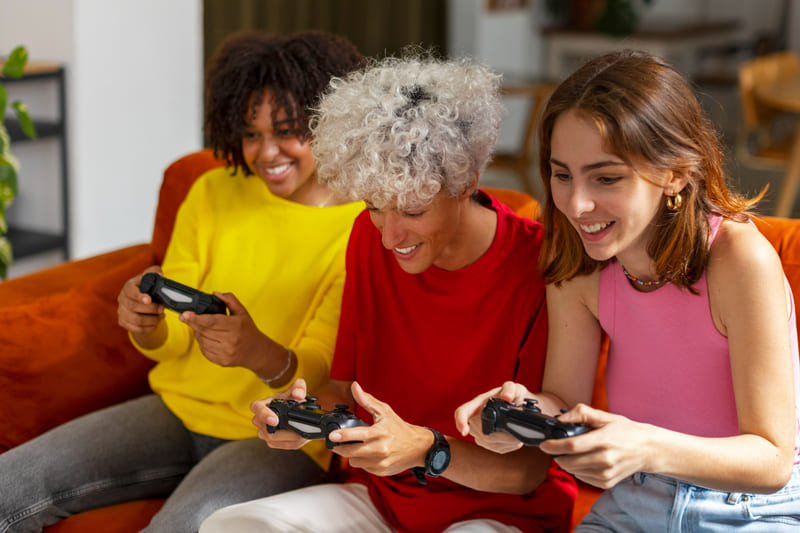
Community trends have recently become a fundamental guide for shaping modern games. Gamers don’t just play; they talk, react, create memes, develop meta strategies, and invent new slang that quickly spreads across platforms like Discord, Reddit, and Twitch.
Terms like ‘sus’ from Among Us moved beyond the game and became part of gaming culture.
Memes and shared community language don’t live in a vacuum; they influence expectations around updates, seasonal events, character dialogues, UI text, and more.
These real-time cultural signals quickly establish the tone and language that players expect when they enter a game’s world.
In the past, many studios handled localization as the last stage—a technical translation stage that simply translated text between languages.
However, in a world where players place a high value on authenticity and relevance and in which community-driven language evolves faster than traditional release cycles, that strategy is inadequate.
A literal translation frequently overlooks context, local jokes, and the daily terminology of community discourse, creating awkward or unnatural dialogue that breaks immersion.
Adaptive localization services thrive in this scenario by going beyond static scripts delivered by developers.
They continuously monitor social trends, community sentiment, and patch-by-patch feedback, allowing them to anticipate shifts in language and tone that resonate with players.
Beyond Words: Cultural Mapping, In-Game Emotion, and Micro-Contexts
In the modern global gaming landscape, simply translating words is no longer enough.
Gamers look beyond literal text, interpreting humor, gestures, character uniqueness, and subtle personality traits that are deeply rooted in cultural context.
A joke that is appropriate in a particular location may fall flat or even be offensive in another, since humor is frequently linked to local traditions, shared experiences, and cultural references.
Players feel more immersed when they see their identity, social cues, and cultural humor reflected in the game world.
For example, players in Asia might react strongly to honorifics or subtle social cues that indicate hierarchy and respect. Meanwhile, European players may prefer dry or absurd humor.
On the other hand, the game’s storyline can be appreciated in Latin America through emotive character interactions along with popular slang or terms.
Building immersive experiences that profoundly connect with a variety of audiences requires an understanding of these micro-contexts.
High-quality localization requires cultural mapping, creative rewriting, and an extensive knowledge of each region’s unique linguistic dynamics; it cannot be accomplished through literal translation alone.
In addition to preventing offense and misunderstandings, games that use cultural mapping and adaptive localization foster stronger emotional bonds with players.
Gamers are more intensely involved, more willing to recommend a game, and more committed to long-term loyalty if they perceive their own cultural norms and values represented in the character dynamics of the game’s narrative.
AI Tools Join the Table, but Human Insight Still Decides the Narrative

Source: Freepik.com
The process of making a game’s text and dialogue comprehensible in multiple languages can be accelerated by using artificial intelligence (AI).
AI tools can run linguistic tests, detect context, verify consistency, and simulate branching dialogue paths responding to player actions.
AI can analyze complex dialogue patterns, quickly detect errors, and maintain terminology consistency across multiple languages.
However, these abilities do not take the role of human insight. Because AI trains on past data, it often misses new lingo, emerging community trends, and rapidly evolving game slang.
A popular term now may seem outdated or awkward a month later, and AI rarely recognizes this shift.
AI still struggles to fully understand humor, tone, sarcasm, and emotional meaning, especially if cultural subtext is involved.
Sensitive topics, regional taboos, and community expectations require human judgment to ensure localization is appropriate, engaging, and culturally respectful.
Therefore, human linguists remain the most effective at determining how actual players will react in various locations. They can spot nuances that AI overlooks and avoid cultural mistakes that could affect a game’s reputation.
Developers worldwide are shifting to a hybrid workflow due to these factors.
While human linguists focus on meaning, cultural fit, and narrative intent, AI takes care of the laborious technical checks.
Combining automation’s speed with human insight creates a powerful synergy that delivers the best of both worlds.
Looking to boost your game’s global performance with high-quality localization? Optimize your game by choosing our better, scalable localization solution.
How 2026 Studios Use Localization to Build Trust With Their Global Player Base
Once dialogue is translated poorly or unnaturally, players may notice right away. Overly formal or uncomfortable sentences might seem goofy or emotionally uninteresting in numerous contexts.
It is also important to use culturally appropriate vocabulary.
A word that is usual in a certain society may sound rude, out of date, or overly formal in another society.
That’s why modern localization teams study how players naturally and organically communicate about roles, weapons, abilities, and in-game systems.
When in-game terminology matches community norms, players feel included and immersed, not like outsiders navigating unfamiliar vocabulary.
The same approach applies to communication outside of the game. Players feel cut off from the game if studios use formal, business language to communicate events, promotions, or updates.
However, when those messages sound like the language of their own community—casual, simple, and locally expressive—they feel connected.
All of these elements show how localization has become a strategic pillar rather than a final checklist item.
It has evolved into a workflow for establishing long-term trust among players globally.
Global audiences are more culturally aware, tone-sensitive, and detail-orientated than ever.
As a result, gaming developers today view language, cultural context, and communication style as critical components of their brand identity.
Speequal Games serves as an effective solution in the modern gaming industry. Speequal Games views localization as cultural co-creation rather than a technical task.
Our team specializes in community-driven adaptation by studying how gamers behave, communicate, and interact within their unique gaming cultures.
We manage every element; from voiceover assistance that matches local acting techniques to lore adaptation that reflects local mythology and context.Contact Speequal Games today and let your game interact authentically with players around the world!